
The Ultimate Guide to Selecting a Walk-in Freezer Floor
A commercial walk-in freezer is an ecosystem of precise thermal control, and its single most vulnerable point is right beneath your feet. While facility managers and procurement teams spend weeks auditing compressor efficiencies, R-values of wall panels, and intelligent door-closing mechanisms, the walk-in freezer floor is frequently treated as an afterthought. That is a million-dollar mistake.
Choosing the wrong freezer floor system doesn’t just result in minor energy leaks. It leads to structural failure, buckled concrete slabs, frost heave disasters, and immediate regulatory non-compliance. In cold storage, your floor must withstand brutal thermal stress from below and crushing mechanical loads from above.
This comprehensive guide breaks down how to choose the right walk-in freezer floor for your operations. We will analyze the engineering metrics, load physics, and insulation technologies required to keep your cold chain intact, your energy bills down, and your facility safe.
1. The Physics of Cold Storage Flooring Solutions: Why the Floor Matters
To understand why a specialized commercial freezer flooring setup is mandatory, you have to understand the thermodynamic forces at play. A walk-in freezer operating at -20°C (-4°F) or lower creates a massive thermal differential with the ground beneath it, which sits at a standard ambient temperature of roughly 10°C to 15°C (50°F to 59°F) in most Canadian sub-surfaces.
Without a highly engineered barrier, heat moves relentlessly toward the cold. This thermodynamic reality triggers two catastrophic operational failures:
The Threat of Frost Heaving
When cold penetrates an uninsulated or poorly insulated floor, it freezes the moisture trapped in the soil directly beneath the concrete slab. As this moisture turns to ice, it expands. Over time, this expansion creates an incredible upward force known as frost heaving.
Frost heave will crack your concrete, buckle your insulated freezer floor panels, throw your structural framing out of alignment, and destroy your walk-in freezer from the bottom up. Fixing a frost-heaved floor typically requires a complete facility shutdown and hundreds of thousands of dollars in structural excavation.
Condensation Prevention and Thermal Efficiency
Without proper insulation on the freezer floor, the perimeter of your cold room becomes a thermal bridge. This causes ambient moisture to condense on the warm side of the structure, leading to pooling water, structural rot, and hazardous ice formation right outside the freezer door. A properly engineered cold room flooring system isolates the sub-freezing environment entirely, ensuring absolute condensation prevention and maintaining systemic thermal efficiency.
2. The Core Decision: Insulated Floor Panels vs. Built-In Concrete Floors
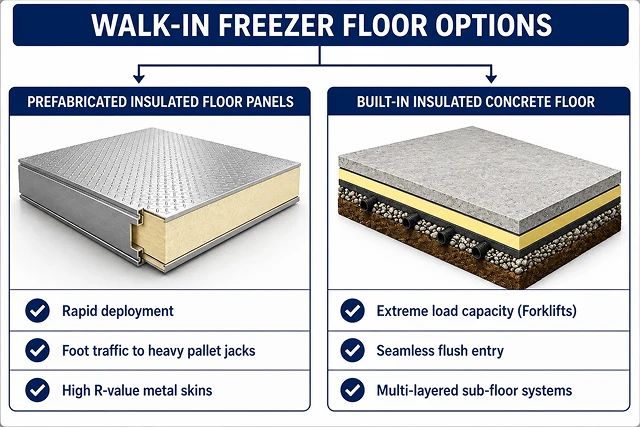
The first architectural fork in the road is deciding between a prefabricated freezer floor utilizing insulated metal panels or a custom, poured-in-place built-in concrete flooring system.
Option A: Prefabricated Insulated Freezer Floor Panels
These are engineered, modular panels manufactured in a factory environment and shipped directly to your facility. They consist of a high-density insulating core sandwiched between two rigid metal skins, typically galvanized steel or stainless steel.
- Best For: Small-to-medium walk-ins, foodservice operations, pharmaceutical storage, leased facilities, and applications where rapid deployment is required.
- Pros: Outstanding out-of-the-box R-value insulation, perfect vapor sealing at factory seams, and fast installation. They can be uninstalled and relocated if your business moves.
- Cons: Limited structural capacity. Standard panels cannot support heavy industrial vehicles like forklifts without specialized overlay reinforcements.
Option B: Built-In Insulated Concrete Flooring Systems
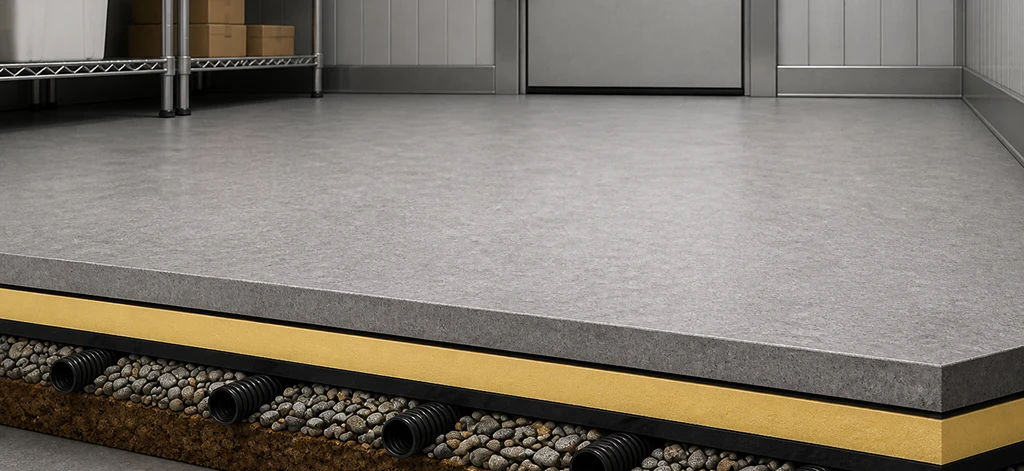
For heavy industrial operations, a custom-built floor is engineered directly into the building’s foundation. This process requires excavating a pit, laying down an underfloor ventilation or heating network, installing a high-spec vapor barrier, laying rigid freezer floor insulation boards, and pouring a final reinforced concrete wear slab.
- Best For: Large-scale distribution centers, industrial cold storage warehouses, food processing plants, and facilities utilizing heavy machinery.
- Pros: Maximum forklift traffic resistance, virtually unlimited floor load capacity, a completely flush transition from the warehouse floor into the freezer, and an incredibly long operational lifespan.
- Cons: High initial capital expenditure, lengthy installation timelines, and a completely permanent structural footprint.
3. Insulation Material Science: Polyurethane Foam vs. Extruded Polystyrene (XPS)
The thermal performance of your floor depends entirely on its core insulation. In 2026, compliance with energy standards like ASHRAE 90.1 requires strict minimum R-values for cold storage applications. For walk-in freezers, you must achieve a minimum rating of R-32, though high-efficiency facilities target R-40 or greater. Two dominant materials provide the thermal resistance needed for refrigerated storage flooring:
Polyurethane Foam (PUR / PIR)
Polyurethane is the industry standard for prefabricated freezer floor panels. It is blown directly into the panel core under high pressure, creating a continuous, void-free insulation layer that bonds perfectly to the metal skins.
- R-Value: Exceptional thermal resistance, typically yielding R-7 to R-8 per inch of thickness. This allows you to achieve mandatory ASHRAE targets with a thinner floor thickness (usually 4 to 5 inches).
- Structure: Closed-cell structure that inherently resists moisture absorption, which is critical if an internal spill occurs.
Extruded Polystyrene (XPS)
XPS is the preferred choice for custom, built-in industrial concrete flooring systems. These are rigid foam boards laid manually beneath the reinforced concrete slab.
- R-Value: Typically ranges from R-5 per inch of thickness. Achieving an R-32 to R-40 rating requires a thicker profile, often necessitating 6 to 8 inches of layered insulation.
- Compressive Strength: The primary advantage of XPS is its incredible structural density. It offers exceptional compressive strength (up to 100 psi or more), allowing it to support the massive dead weight of a reinforced concrete wear slab combined with live forklift loads without compressing or degrading.
4. Engineering for Load Capacity and Traffic Resistance
Structural failure occurs when a facility incorrectly matches its daily traffic patterns with the wrong floor load capacity. To keep your industrial freezer flooring from buckling, your procurement team must design for peak dynamic loads, not just average static weight.
| Traffic Profile | Typical Equipment | Recommended Floor Architecture | Minimum Load Rating |
|---|---|---|---|
| Light Commercial | Foot traffic, small wire shelving, dunnage racks | Standard insulated freezer floor panels (Smooth or diamond tread aluminum/steel) | 600 – 1,000 lbs/sq. ft. static load |
| Medium Commercial | Heavy hand trucks, 2-wheel dollies, manual pallet jacks | Reinforced panel flooring with internal marine-grade plywood underlayment + heavy gauge stainless steel skin | 2,000 – 3,000 lbs/sq. ft. static load |
| Industrial / B2B Logistics | Electric pallet jacks, stand-up riders, counterbalanced forklifts | Poured-in-place reinforced concrete over high-density XPS insulation boards | 4,000+ lbs/sq. ft. static load / 12,000+ lbs axle load |
Achieving Forklift Traffic Resistance
If a heavy electric pallet jack or forklift drives onto a standard insulated metal panel, the concentrated wheel load will instantly puncture the metal skin and crush the underlying foam core. If your B2B workflow requires heavy machinery inside the freezer, you must opt for a flush-concrete built-in design or utilize heavy-duty track plates designed to distribute dynamic axle loads across reinforced panel surfaces.
5. The Shield: Vapor Barriers and Underfloor Heating Systems
The parts of a freezer floor system you cannot see are often the most critical for preventing structural failure. In sub-freezing applications, managing moisture and sub-slab temperatures is a continuous engineering challenge.
The Imperative of the Vapor Barrier
Moisture moves from warm environments to cold environments. In a walk-in freezer, the warm, humid air outside the room attempts to drive vapor through the walls and floor toward the sub-zero interior.
If this moisture penetrates your insulation, it will freeze, expand, destroy the insulation’s thermal value, and cause catastrophic delamination. A high-performance vapor barrier, typically a minimum 6-mil to 10-mil polyethylene or puncture-resistant composite sheet, must be sealed flawlessly on the warm side of the floor insulation. This simple barrier provides indispensable moisture protection that preserves the lifespan of the entire system.
Underfloor Heating Systems: Preventing the Deep Freeze
For industrial freezers built directly on a ground slab, a high-efficiency insulation layer is not enough to stop frost heaving over long operational timelines. Residual cold will eventually migrate past the insulation and freeze the sub-soil.
To eliminate this risk, modern B2B facilities install an underfloor heating system. This system maintains the soil temperature just above freezing (around 2°C to 4°C / 36°F to 39°F) through two common methods:
- Forced Air Ventilation: A grid of PVC or heavy-duty pipes embedded in a gravel layer beneath the insulation that allows ambient warehouse air to naturally circulate and warm the ground.
- Electric/Hydronic Heat Tracing: A network of low-wattage electric heating cables or hydronic tubes that monitor sub-slab temperatures via sensors and engage automatically to prevent the ground from freezing.
6. Skin Materials: Galvanized Steel vs. Stainless Steel vs. Aluminum
If you choose a prefabricated walk-in cooler and freezer flooring system, the material finish of the metal skin directly dictates the durability, sanitary compliance, and lifespan of your unit.
| Material | Corrosion Resistance | Sanitation Rating | Cost Level |
|---|---|---|---|
| Galvanized Steel | Moderate | Standard Industrial | Cost-Effective |
| Aluminum | High (No Rust) | Food-Grade | Mid-Tier |
| Stainless Steel | Maximum (Chemicals) | Premium/Pharma | Premium |
Galvanized Steel
Heavy-gauge galvanized steel coated with zinc offers excellent structural rigidity and impact resistance at an affordable price point. It handles the abrasion of rolling carts well, but can oxidize and corrode over time if exposed to harsh sanitizing chemicals or acidic food spills.
Stainless Steel
The gold standard for food-grade flooring. Stainless steel is highly resistant to puncture, impact, rust, and chemical corrosion. It can withstand aggressive daily washdowns using caustic sanitizers without pitting or degrading. This makes it mandatory for pharmaceutical applications, meat processing plants, and high-salinity seafood storage.
Aluminum (Smooth vs. Diamond Treadplate)
Aluminum is highly resistant to corrosion and naturally lightweight. However, smooth aluminum surfaces become dangerously slick when covered in frost or moisture. If you select aluminum or steel for a walking surface, it should feature an embossed anti-slip surface or a raised diamond treadplate pattern to provide traction and ensure workplace safety.
7. Compliance, Safety, and Food-Grade Standards
Every B2B cold storage installation must satisfy regulatory bodies and international standards. When selecting your floor system, keep these three priorities in mind:
- Sanitary Design and NSF Standards: For food service and processing, your floor must be non-porous, easy to clean, and free of crevices where bacteria can harbor. Ensure your floor system meets International Organization for Standardization (ISO) hygiene frameworks and NSF criteria. Wall-to-floor intersections should feature a coved profile to allow complete washdown capabilities.
- Anti-Slip Surface Engineering: Workplace safety is a primary operational risk. Cold rooms are prone to flash-frosting when warm air enters during door cycles. Specifying a diamond-tread finish, an abrasive aggregate coating, or slip-resistant floor mats is necessary to prevent slip-and-fall injuries.
- ASHRAE 90.1 Energy Optimization: As energy prices fluctuate, building an energy-efficient freezer design is a financial necessity. Ensure your floor insulation configuration minimizes thermal bridging and compressor run times, keeping your facility fully compliant with federal and provincial energy mandates.
The COLDMOOSE Advantage: Engineering the Perfect Foundation
Choosing the right walk-in freezer floor requires balancing upfront capital expenditure with long-term operational costs. Cutting corners on insulation thickness, vapor barrier sealing, or structural load capacity will inevitably lead to compounding energy losses and catastrophic structural failure.
At COLDMOOSE, we engineer custom cold storage flooring solutions tailored to your specific logistical workflows, load demands, and efficiency targets. Whether you need an ultra-durable, heavy-traffic custom freezer floor panel array or a perfectly isolated industrial concrete sub-floor design, our engineering team ensures your facility remains durable, efficient, and compliant.
Ready to build a reliable cold storage facility? Contact the COLDMOOSE engineering team today for a comprehensive operational audit and a precision-engineered quote for your next project.