
Dairy Refrigeration Solutions in Ontario, Canada
From the moment raw milk leaves the udder until final packaging, temperature control is essential to maintaining product quality and safety. In commercial dairy operations, refrigeration is far more than storage. It prevents bacterial growth, reduces spoilage, and protects product integrity.
COLDMOOSE designs, builds, and services heavy-duty dairy refrigeration systems tailored for the demanding needs of Canadian farms and processing facilities. Our solutions help preserve yield, reduce energy costs, and ensure compliance with industry safety standards.

Technical Specifications & Milk Thermal Cascades
Raw milk exits the animal at approximately 38°C, an ideal environment for rapid microbial proliferation. To secure long-term dairy product freshness and prevent spoilage, the thermal mass must be dropped below 4°C within strict statutory windows.
| Processing Environment / Stage | Critical Target Temperature | Recommended Relative Humidity (RH) | Primary Mechanical Infrastructure |
|---|---|---|---|
| Bulk Milk Chilling (Farm Level) | 3°C to 4°C | N/A (Closed Tank Environment) | Direct expansion (DX) or ice-bank fluid systems |
| Raw Milk Storage Tanks (Plant Level) | 2°C to 4°C | N/A (Sealed Atmosphere) | Vertical/Horizontal milk storage refrigeration tanks |
| Pasteurization Cooling Section | Rapid drop to 4°C | N/A (Plate Heat Exchangers) | Heavy-duty glycol-driven industrial dairy chillers |
| Cultured Products Staging (Yogurt) | 40°C down to 4°C | 55% to 65% | Multi-stage blast cells with custom airflow controls |
| Butter Storage & Hardening Cells | -18°C to -23°C | 75% to 80% | High-velocity industrial walk-in freezers |
| Finished Product Distribution Vaults | 2°C to 4°C | 65% to 75% | Medium-temp walk-in cooler & freezer combo units |
Thermal Mechanics of Milk Processing Plant Cooling Systems
Managing the extreme heat loads of pasteurization requires a synchronized thermodynamic balance. Systems must instantly drop milk temperatures immediately following high-temperature processing.
The engineering diagram above highlights the critical role of a centralized fluid chiller loop. By passing pasteurized milk through a high-efficiency plate heat exchanger (HXD), the thermal load is instantly transferred to a secondary glycol loop, dropping the fluid temperature safely to 4°C before it enters the final packaging lines.
The Critical Milk Chilling Sequence
At the facility level, safeguarding raw product requires an unbroken sequence of automated thermal extraction steps. Any delay in this initial pull-down cycle permanently degrades product stability and shelf life.

Primary Inline Pre-Cooling
Raw milk is pumped directly from the milking line through an inline plate heat exchanger before it ever reaches the bulk tank. By running cold well water or chilled glycol counter-current to the milk flow, we mechanically strip out up to 70% of the initial sensible heat, dropping temperatures from 38°C to roughly 10°C instantly.

Secondary Bulk Tank Solidification
The pre-cooled product enters specialized milk storage refrigeration tanks. Our high-torque automated milk cooling systems engage direct-expansion cooling surfaces along the bottom and sides of the vessel, gently agitating the fluid to drop the entire thermal mass to a stable 3.3°C to 4°C.

Shock-Chilling Thermal Interception
During downstream pasteurization, milk is heated to a minimum of 72°C. Immediately after holding, our high-capacity milk pasteurization cooling systems use dedicated industrial dairy chillers to shock the milk back down to 4°C in seconds, protecting flavor profiles and stopping thermophilic bacterial survival.
High-Demand Regions: Ontario’s Dairy Processing Belts
Our customized and specialized industrial design, dairy cooling solutions Ontario services, and experienced engineering teams operate across the province's highest-output agricultural and municipal processing sectors:
Southwestern Ontario (Woodstock, Stratford, London, and Elora)
Known as the heartland of Ontario's dairy farming industry, requiring continuous dairy farm refrigeration systems, bulk tank modernizations, and responsive dairy refrigeration services.
The Greater Golden Horseshoe (Toronto, Brampton, Hamilton, and Winchester)
High-capacity corporate processing epicenters that demand huge milk processing plant cooling systems, high-output industrial milk refrigeration, and deep-capacity finished product distribution infrastructure.
Eastern Ontario & Ottawa Valley (Navan, Kemptville, and Cornwall)
major corridors for regional dairy processing plants, cheese production facilities, and cold chain distribution hubs requiring high-efficiency custom dairy refrigeration systems
Key Infrastructure & Heavy-Duty Cold Chain Equipment
At COLDMOOSE, we specialize in designing, manufacturing, installing, and servicing the foundational hardware that drives modern commercial milk refrigeration systems:
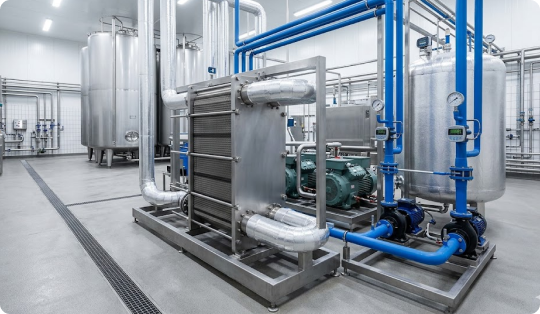
Industrial Fluid Chillers & Milk Chilling Systems
We design and engineer heavy-duty dairy chillers using both direct-expansion and secondary fluid architectures. By utilizing food-safe propylene glycol loops, our milk chilling systems provide massive cooling reserves capable of bearing the intense thermal spikes common during CIP (Clean-In-Place) washdown transitions and high-volume pasteurization runs.
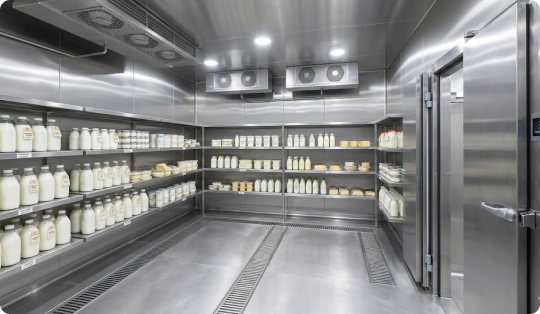
Hygienic Dairy Refrigeration Systems & Walk-in Coolers
Our custom-built walk-in coolers and storage vaults feature completely seamless, wipe-down panels designed to resist organic acid corrosion and aggressive sanitation chemicals. Sloped stainless steel drain channels and anti-microbial fan casings prevent standing moisture, ensuring a clean storage environment for high-value dairy derivatives.
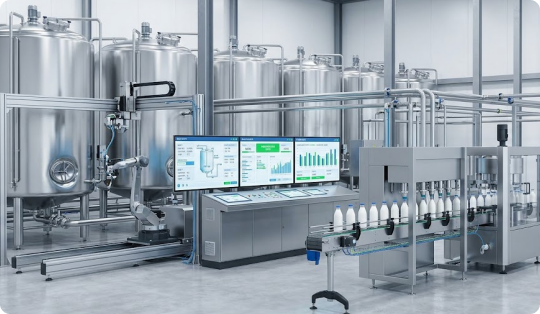
Automated Bulk Storage & Processing Automation
Modern fluid processing demands smart coordination. We engineer dairy processing automation platforms directly into your cooling hardware, allowing your units to dynamically sync with internal production volumes, agitation speeds, and filling line schedules.
Core Risks of Inadequate Cold Chain Infrastructure
Attempting to run a high-throughput dairy operation using standard, non-specialized commercial equipment creates immediate biological and financial liabilities:

Bacterial Proliferation & Spoilage
Milk is highly vulnerable to rapid bacterial growth. If your milk cooling systems fail to maintain temperatures below 4°C, psychrotrophic bacteria multiply, producing heat-stable enzymes that ruin the flavor, smell, and usability of the entire batch.

Thermal Shock and Separation Risks
Inconsistent temperature management inside milk storage refrigeration tanks can cause fat separation and inconsistent butterfat blending. This structural breakdown lowers the grade of your raw product and hurts your financial returns.

Uncontrolled Energy Tariffs
Dairy plants consume massive amounts of power during pasteurization cooling loops. Outdated, poorly configured systems without smart cooling technology run continuously at peak capacity, driving up operating costs and straining your facility's bottom line.
System Engineering & Energy Efficiency Upgrades
Our industrial engineering division builds equipment designed for long-term thermal efficiency, low maintenance costs, and minimal environmental impact.

Dairy Refrigeration Energy Efficiency & Advanced Recovery
We future-proof your processing footprint by capturing waste energy. Our custom dairy refrigeration systems can be configured with integrated heat reclamation loops. This allows the system to harvest the latent heat extracted from raw milk and repurpose it to pre-heat wash water for the facility's CIP systems, reducing overall boiler loads and cutting utility bills by up to 40%.

Smart Cooling Technology & HVAC Refrigeration Integration
Our automated controls use precise electronic expansion valves and variable-speed compressor arrays that adjust in real-time. By integrating your space-cooling HVAC units with your core dairy equipment refrigeration loops, we create a unified, automated thermal grid that prevents short-cycling during low-load production windows.

Eco-Friendly Refrigeration Technology
We help eliminate compliance liabilities linked to the ongoing phase-down of high-GWP synthetic refrigerants under Canadian environmental laws. We specialize in engineering and installing natural refrigerant solutions, including Transcritical CO₂ (R-744) and low-charge Ammonia (R-717) installations, protecting your facility from future carbon taxes and regulatory penalties.
Absolute Regulatory Compliance: CFIA & HACCP
In Canada's commercial dairy processing sectors, food safety regulations dictate your ability to operate. Every system we build maps directly to strict national and international compliance benchmarks:
 HACCP Compliant Cold Chain Infrastructure
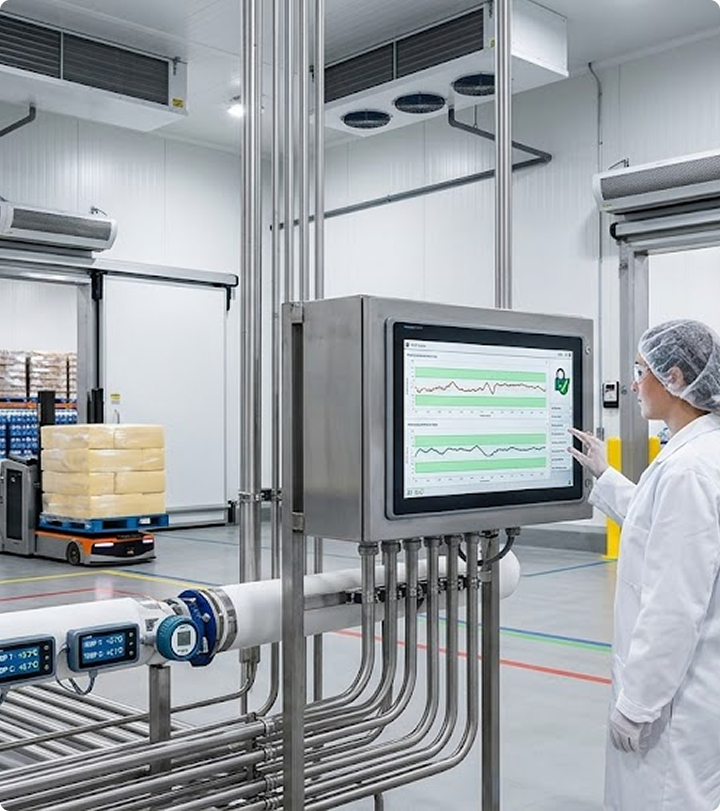
Temperature maintenance is the fundamental critical control point (CCP) within any dairy facility's food safety program. Our control networks include secure, automated data logging and remote monitoring tools to provide QA managers with continuous, unalterable temperature charts for regulatory audits.
 Safe Food for Canadians Regulations (SFCR) Alignment
Our industrial designs maintain the precise temperature logging and air-quality boundaries required by the Canadian Food Inspection Agency (CFIA) for domestic distribution and international export markets.
 Provincial Codes & Quality Standards
Every dairy cold room installation we execute complies with CSA, ESA, TSSA, and local mechanical codes, ensuring a smooth, hassle-free transition from initial commissioning to final inspection.
Flexible Capital & Acquisition Models: Leasing & Rentals
Engineering custom industrial cooling systems requires significant capital allocation. To help Canadian processors scale efficiently without straining cash flow, we provide flexible, business-focused acquisition models designed to fit your operational budget.

Commercial Leasing & Asset Financing
Through strategic financing partnerships, COLDMOOSE offers tailored leasing structures that allow you to design, build, and install a complete, custom dairy cold storage solution or processing facility with zero upfront capital.
- Preserve Working Capital
- Rapid Upgrades

Scalable Short-Term & Seasonal Rental Solutions
For operations facing temporary capacity overloads, seasonal production spikes, or emergency system breakdowns, COLDMOOSE maintains a fleet of ready-to-deploy, commercial-grade refrigeration units.
- Turnkey Setup
- Predictable Operational Costs

Technical FAQ for Dairy Plant Operations
Why are secondary glycol loops preferred over direct expansion systems in processing rooms?
Usually, secondary glycol systems isolate the primary refrigerant charge inside a central mechanical room, using a non-toxic water-glycol mixture to cool production zones. This approach completely removes any risk of refrigerant leaks in active food-handling spaces, ensures highly stable temperature control, and simplifies maintenance across the plant floor.
What is the mechanical cause of milk freezing on bulk tank plates, and how do you prevent it?
Milk freezing generally occurs when the compressor engages before the level of liquid in the tank completely covers the evaporator surface, or when agitation speeds are too low. Our automated milk cooling systems use modern level-sensing controls and variable-speed mixers to guarantee that cooling cycles match fluid volumes, preventing structural freezing that damages milk proteins.
How often should industrial dairy processing refrigeration maintenance be executed?
For maximum runtime and efficiency, a comprehensive maintenance routine should be performed quarterly. This process includes the following things:
- Testing compressor oil acidity
- Checking plate heat exchanger gasket integrity
- Calibrating electronic expansion valves
- Verifying that automated data logging platforms are communicating accurately with your plant's internal networks.
Engineer Your Cold Chain Operations
Inefficient cooling, product spoilage, or regulatory concerns limit your production margins. Partner with COLDMOOSE today and be a part of Canada's trusted industrial refrigeration engineering team to design, build, and maintain a high-performance system customized for your facility's exact footprint.
Contact our industrial engineering division today for a technical consultation, system energy audit, or a comprehensive project estimate.
Get in Touch with COLDMOOSE Refrigeration Experts
Fill out the form below to request a consultation, get a custom quote, or discuss your dairy refrigeration needs. Our team will respond quickly to help you design the right cold storage solution for your farm or facility.
Head Office & Manufacturing
41 Ardelt Pl, Kitchener, ON N2C 2C8